

While part of data center energy consumption is incompressible, another part can be significantly reduced thanks to many technological advances. A closer look at these energy optimization levers.
According to data from EY-Parthenon, France had around 250 commercial data centers in 2022. Mostly located in the Île-de-France region and in the southeast of the country, these data centers vary widely in size, storage capacity and power consumption. Their installed available capacity stood at 566 MW, up 16% per year since 2016. It is expected to keep growing to reach 1.8 GW in 2033, an increase of 11% per year over the coming years.
Part of the energy consumption of these data centers can be reduced, but another part is simply incompressible. The reason is straightforward: value creation in the digital sector inevitably involves consuming kilowatts, drawn by processors, graphics cards, hard drives and other electronic components. Even though the efficiency of these components improves year after year, an irreducible share remains, whatever the configuration chosen.
Programming languages, an underrated lever for energy optimization
“If developers make the effort to code in C++ rather than Python, the effects on energy consumption will be immediate”
That said, many levers exist to reduce the energy consumed by data centers. Programming languages are one of them. In a study published in 2021, researchers examined 27 different languages, analyzing them against three criteria: energy consumption, execution time and peak memory usage.
Compiled languages (C, C++, Pascal, Fortran...) take the top spots in the ranking, ahead of interpreted languages (JavaScript, PHP...) and virtual machine languages (Java, C#...). Looking at energy consumption alone, the ratio can range from 1 to 75, or even 80 (1 for C, 75.88 for Python and 79.58 for Perl).
“If developers make the effort to code in C++ rather than Python, the effects will be immediate. To help them, generative AI may soon make it easy to convert programs from one language to another,” says Damien Desanti, Founder and CEO of PHOCEA DC.
PUE, the other lever for reducing energy consumption
“By fully immersing server components in a non-conductive liquid, immersion cooling makes it possible to achieve server densities a hundred times higher than those available just a few years ago”
Another, better-known optimization lever is PUE (Power Usage Effectiveness). This indicator is calculated by dividing the total energy consumed by the data center by the total energy used by IT equipment (servers). It reflects a data center's ability to control its energy efficiency. In recent years, many innovations have helped lower data center PUE, including improvements in the efficiency of the UPS power chain, which is now close to 100%.
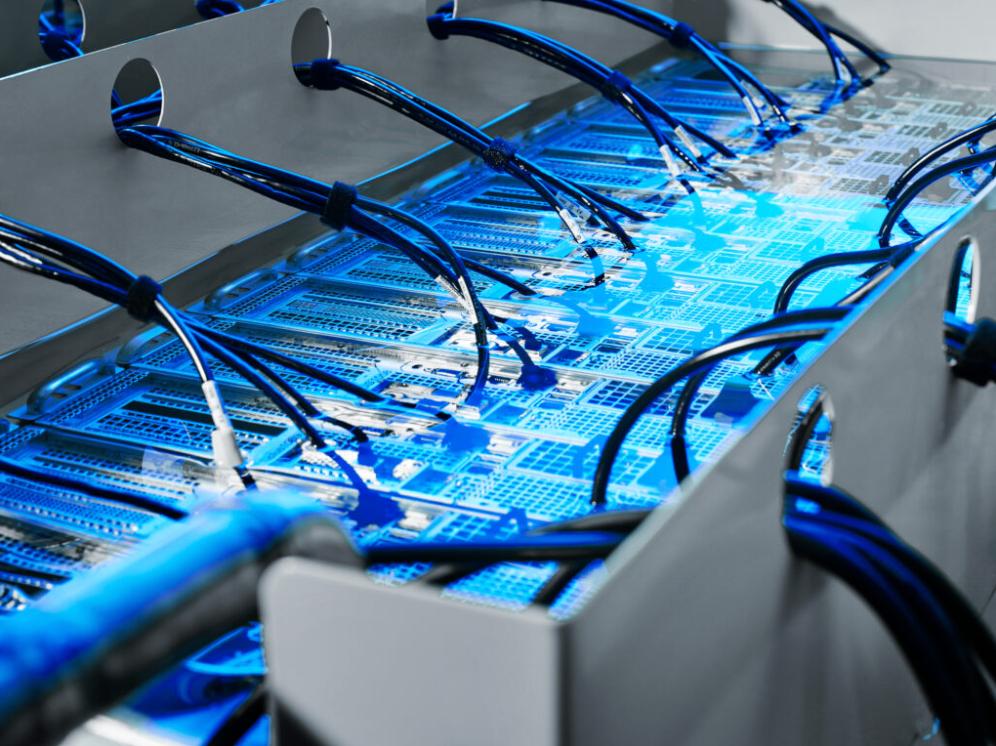
Immersion cooling also helps lower data center PUE. “By fully immersing server components in a non-conductive liquid, it makes it possible to achieve server densities a hundred times higher than those available just a few years ago, reaching densities of around 300 kVA per IT rack, which corresponds to the maximum electrical load such an installation can support,” notes Damien Desanti.
Artificial intelligence to manage data centers and their consumption
Artificial intelligence will also bring its share of benefits to data centers. “There are so many parameters to manage in a data center, for each piece of equipment (diesel generator, chiller, UPS...), that only AI can integrate all of this information to propose relevant optimizations and changes,” adds Damien Desanti.

By ingesting hundreds of efficiency curves for the installed equipment upfront and connecting to thousands of sensors operating in real time, AI technologies make the building that houses the data center truly intelligent. “Responsiveness is another benefit of AI. If a customer installs 20 or 30 racks in a data hall in a single day, the AI will immediately detect it and analyze traffic and consumption, while managing the equipment so that efficiency always stays at its maximum, which is beneficial from an energy standpoint,” explains Damien Desanti.
Learn more about PHOCEA DC, a provider of sovereign, eco-responsible data centers. Phocea DC is based in Marseille. Its data center covers 1,700 m² with 1.2 MW of power. Compliant with the Tier III standard, it will combine reliability and energy efficiency. Its hosting services are designed for local and national organizations: local authorities, businesses, telecom operators and managed service providers.